






WeChat ID :


Login/Register


 Posted on 16 Oct 2026
 7
7


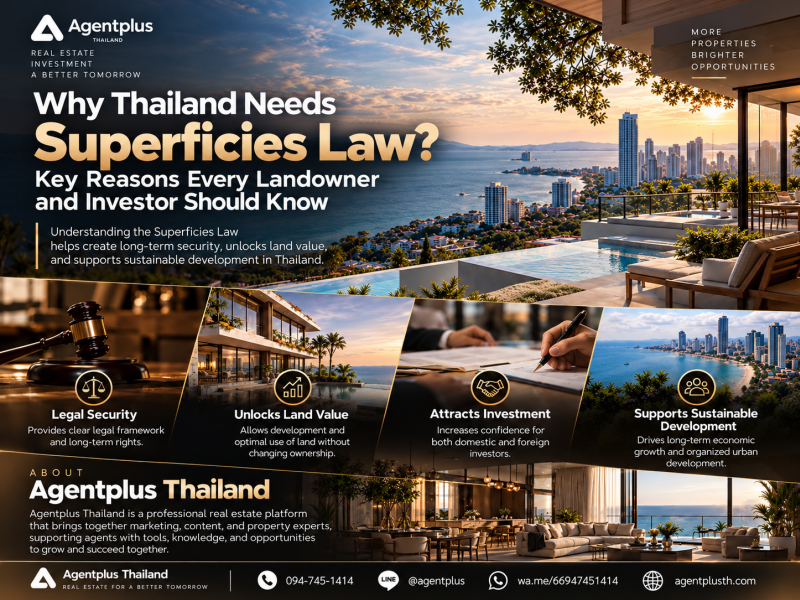
What happens when a landowner wants to retain ownership, but a developer needs a clearly defined right to use the property? That question helps explain why Thailand introduced the Rights over Leasehold Asset Act B.E. 2562 (2019). The law provides a framework for creating a registered property-use right without necessarily transferring ownership of the underlying real estate AGO.
The MODULE 2 material identifies several issues behind the law: limitations of long-term leases, investor concerns, owners who do not want to sell land, and large projects that may need a different rights structure. A Right over Leasehold Asset, known in Thai as Sap-Ing-Sith, is an additional option—not a replacement for every lease or purchase.
Buying land may not be practical or desirable for every project. An owner may want to retain title, while a developer or investor needs sufficient clarity about how the property can be used during the project period.
A conventional lease remains useful in many situations. However, parties considering a substantial project may also need to examine how rights can be transferred, inherited, or used in a financing arrangement. Those questions require more than an attractive property listing; they require a careful review of the legal structure.
The position of foreign participants also needs to be understood accurately. Holding a Right over Leasehold Asset does not itself make a foreign holder the owner of Thai land, nor does it remove other applicable legal restrictions.
Under the Act, a Right over Leasehold Asset is a legally recognized asset based on the right to use and benefit from specified real estate. Its establishment involves an application by the property owner and registration with the relevant official. The right may be established for no more than 30 years AGO.
The MODULE 2 material describes the overall process as owner → agreement → registration → creation of the right. It also highlights potential rights to use, possess, transfer, lease out, mortgage, and pass on the right through inheritance, subject to applicable law and transaction conditions.
The distinction is essential: the underlying ownership remains separate from the registered right to use the property. The possibility of mortgaging a right also does not mean financing is automatically available; a lender must still assess the transaction.
MODULE 2 identifies hotels, resorts, wellness residences, mixed-use projects, medical facilities, senior living, and industrial or logistics developments as examples of sectors where the structure may be considered. It also discusses investment contexts such as the Eastern Economic Corridor and foreign direct investment.
This does not mean every such project should use Sap-Ing-Sith. It means parties may benefit from comparing available structures when an owner wishes to retain ownership and another party intends to develop or use the property over time.
Other requirements—including planning, building, environmental, tax, and project-specific rules—still apply. A registered property-use right is not a substitute for permits or legal due diligence.
Before establishing or acquiring the right, parties should review the title documents, permitted use, remaining term, existing encumbrances, payment obligations, maintenance responsibilities, and conditions for termination. They should also obtain legal and tax advice specific to the property and intended transaction.
Agentplus Thailand can describe its role as a real estate broker and property investment consultant helping owners, developers, buyers, and investors explore property options and coordinate relevant transaction information. Where registered property rights or legal interpretation are involved, the company should work alongside qualified legal professionals rather than present brokerage advice as a legal opinion.
Suggested company description: “Agentplus Thailand provides real estate brokerage and property investment consulting services, helping clients evaluate property opportunities and understand transaction considerations, including registered property-use rights.”
In short, Thailand’s Rights over Leasehold Asset Act provides another way to structure the use of real estate when outright ownership or a conventional lease may not meet every party’s objectives. Whether it is suitable depends on the property, the parties, and the terms of the transaction.