






WeChat ID :


Login/Register


 Posted on 7 Oct 2026
 5
5


Special Analytical Report: Essential Rental Laws Every Professional Real Estate Agent Must Know — Because Law Supersedes Contracts
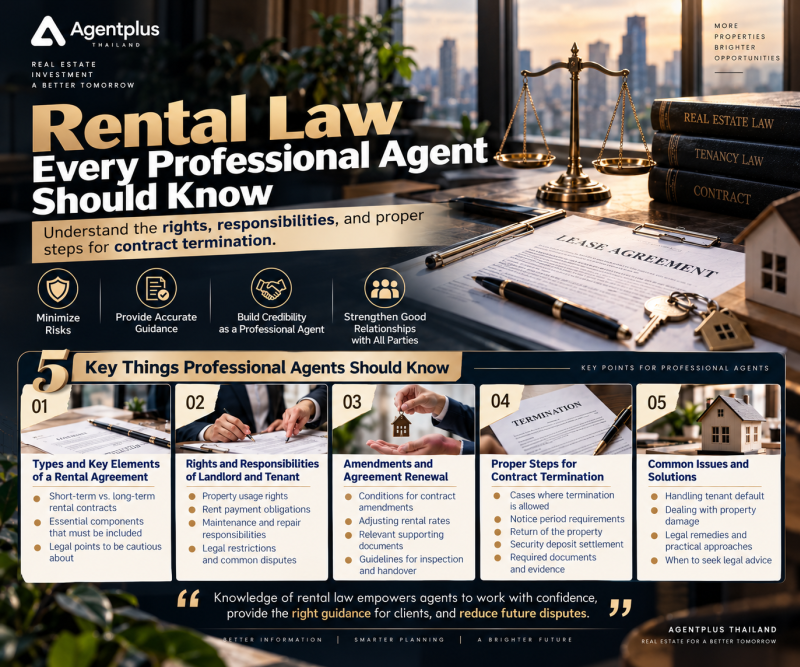
Many people believe that "a contract is the law," but in reality, the law supersedes contracts. For a Professional Real Estate Agent, mastering rental laws is not just about protecting the interests of landlords and tenants; it is about mitigating legal risks and preventing disputes. This expertise is what separates true professionals from general brokers.
A lease agreement is a contract where the landlord allows the tenant to use or benefit from an asset temporarily, in exchange for rent. There are three essential elements:
The Asset: Such as a house, condo, land, or commercial building.
The Right to Use: The tenant gains the right to utilize the property, but does not gain ownership.
Consideration (Rent): If there is no rent paid, the relationship may be legally classified as a "loan for use," not a lease.
A lease is a reciprocal contract (asset use in exchange for rent) and is inherently temporary. Once the term expires, the rights extinguish unless renewed.
To prevent conflicts, agents must clearly explain the boundaries of rights and duties:
Landlord (Lessor):
Rights: To receive rent on time, inspect the property (with advance notice without causing undue disturbance), and claim damages or terminate the lease if the tenant breaches the contract.
Duties: To deliver the property in a safe and usable condition, perform necessary repairs as dictated by law or contract, not disturb the tenant's peaceful possession, and return the security deposit if no damages occur.
Tenant (Lessee):
Rights: To receive a safe property, use it for its intended purpose, and enjoy protection from arbitrary disturbances (e.g., the landlord cannot arbitrarily cut off water/electricity or change locks).
Breach of Duties: Non-payment of rent, damaging the property, unauthorized subletting, prohibited activities (like keeping pets against rules), or unauthorized structural modifications.
Leases typically terminate upon expiration, mutual consent, or due to a breach of contract. In the event of a breach, a landlord cannot arbitrarily evict the tenant. They must follow strict legal procedures:
Written Notice: Send a formal warning letter.
Opportunity to Rectify: Provide a reasonable timeframe for the tenant to fix the issue.
Failure to Rectify: If the tenant ignores the notice.
Lease Termination: The contract can then be legally terminated.
Claiming Damages: Landlords can claim damages for property destruction or breach of contract (e.g., unpaid rent). However, not all damages are claimable; they must be actual, provable, and directly linked to the breach of contract.
Rental laws are highly nuanced. Agentplus (Thailand) Co., Ltd., led by CEO Ms. Patima Jirathamrongchat (MissKann)—a certified RE131 licensing course instructor at TREBS—is a premier Professional Brokerage Firm. Agentplus ensures all lease agreements are legally sound, tenants are rigorously vetted, and property management is executed flawlessly to maximize your investment returns.